
The FDA Office of Generic Drugs (OGD) is the backbone of affordable medication in the United States. While most people know the FDA approves new drugs, few realize that nearly 9 in 10 prescriptions filled in the U.S. are for generic versions. Behind that statistic is a highly specialized team working to make sure those generics are just as safe and effective as their brand-name counterparts - without the high price tag. The OGD doesn’t just review applications; it shapes the entire system that brings low-cost medicines to millions.
What the Office of Generic Drugs Actually Does
The OGD’s core mission is simple: get high-quality generic drugs to patients as quickly and safely as possible. But the work behind that mission is complex. Every generic drug must prove it’s bioequivalent to the brand-name version - meaning it delivers the same amount of active ingredient into the bloodstream at the same rate. That’s not just a formality. A 5% difference in absorption could mean a seizure for someone on epilepsy medication, or a dangerous drop in blood pressure for someone on heart drugs.
The OGD reviews thousands of Abbreviated New Drug Applications (ANDAs) every year. These aren’t full clinical trials like those for new drugs. Instead, they rely on scientific data showing equivalence in how the drug behaves in the body. But even abbreviated reviews require deep expertise in pharmacokinetics, chemistry, manufacturing, and clinical outcomes. Each application is assigned a Regulatory Project Manager who tracks progress, ensures deadlines are met, and coordinates between different review teams.
OGD also handles patent and exclusivity issues under the Hatch-Waxman Act. This 1984 law created the balance between protecting innovation and encouraging competition. When a brand-name drug’s patent expires, generic manufacturers can file an ANDA. But if the brand company claims additional exclusivity - say, for a new use or formulation - OGD must evaluate whether that claim is valid. These decisions directly impact when a generic can enter the market, and sometimes, who gets to be the first generic on the market. That first-to-file company gets 180 days of exclusivity, a huge financial incentive that drives competition.
How OGD Is Structured to Handle Complex Work
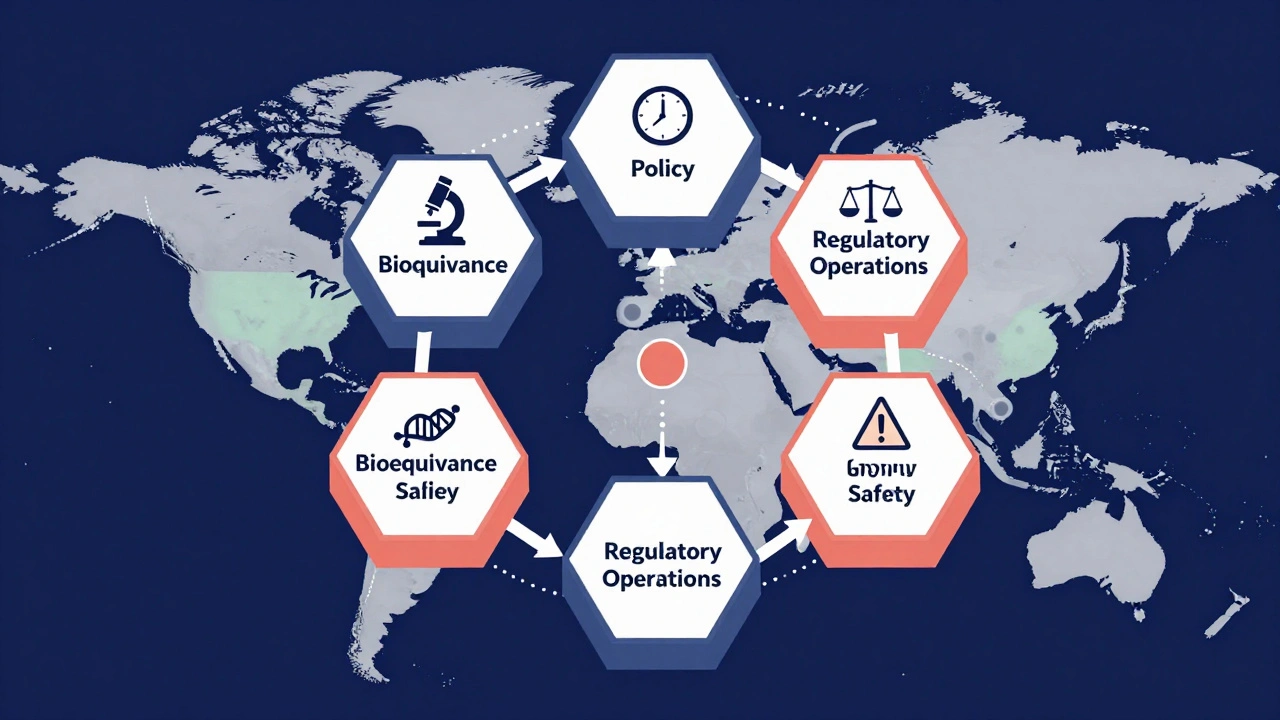
OGD isn’t one big team. It’s a carefully organized system of five specialized offices, all led by the Immediate Office. This structure lets experts focus on their area while ensuring coordination across the board.
The Immediate Office sets strategy, manages resources, and serves as the top authority on all generic drug matters. It includes the Global Generic Drug Affairs Team, which works with regulators in Europe, Canada, India, and elsewhere to align standards and avoid duplication. It also houses the Division of Legal and Regulatory Support - the team that knows every twist and turn of the Hatch-Waxman Act. They’re the ones who advise on patent certifications, exclusivity periods, and legal challenges that can delay approvals.
The Office of Bioequivalence is where the science gets real. This team designs and evaluates studies that prove a generic drug behaves the same as the brand. They decide what tests are needed - whether it’s blood sampling in healthy volunteers or complex modeling for drugs with unusual absorption patterns. Their work ensures that a pill made in India or Tennessee will have the same effect in your body.
The Office of Generic Drug Policy doesn’t just interpret rules - it creates them. When new science emerges, or when manufacturers face unclear guidance, this office writes the policies that clarify how to meet FDA standards. They’ve tackled issues like how to handle complex drug delivery systems, such as inhalers or injectables, where small changes in manufacturing can alter how the drug works.
The Office of Regulatory Operations is the engine room. It’s where applications are filed, checked for completeness, and assigned to reviewers. The Division of Project Management assigns each ANDA to a Regulatory Project Manager who shepherds it through the entire review process. These managers don’t just track deadlines - they anticipate bottlenecks, push back on incomplete submissions, and coordinate with other FDA offices when safety concerns arise.
The Office of Research and Standards builds the tools reviewers use. They develop analytical methods to test drug purity, create models to predict how a drug behaves under different conditions, and establish quality standards for manufacturing. Their research directly influences what data manufacturers must submit and how strictly it’s evaluated.
And then there’s the Office of Safety and Clinical Evaluation. Generic drugs aren’t risk-free. When adverse events are reported - say, a rash, dizziness, or worse - this team investigates whether it’s the drug itself, a manufacturing flaw, or something else. They work closely with the FDA’s Center for Disease Control and other agencies to track signals across millions of prescriptions.
The GDUFA Framework: Funding the Review Process
Before 2012, the FDA relied on taxpayer money to review generic drugs. That meant long delays - sometimes over three years - because budgets were tight and staff were stretched thin. The Generic Drug User Fee Amendments (GDUFA), first passed in 2012 and renewed every five years since, changed that.
Under GDUFA, generic drug manufacturers pay fees to the FDA when they submit an ANDA. Those fees fund the OGD’s operations: hiring more reviewers, upgrading lab equipment, improving IT systems, and reducing backlogs. In return, the FDA commits to meeting strict review timelines. For example, a standard ANDA must be reviewed within 10 months, and first generics within 12 months. These aren’t suggestions - they’re legally binding commitments.
Since GDUFA began, the average review time for generic drugs has dropped from over 30 months to under 12. The number of first generic approvals has more than doubled. That’s not just efficiency - it’s a public health win. More affordable options mean better adherence, fewer skipped doses, and lower overall healthcare costs.

Global Impact and International Coordination
The U.S. isn’t the only country that needs safe, affordable generics. India and China produce over half of the active pharmaceutical ingredients used in American medicines. The OGD’s Global Generic Drug Affairs Team works directly with regulators in those countries to inspect manufacturing sites, share data, and align standards. This isn’t about control - it’s about consistency. A pill made in Hyderabad must meet the same bioequivalence standards as one made in Ohio.
OGD also helps other countries build their own generic review systems. By sharing tools, training reviewers, and publishing guidance documents, the office helps raise global standards. That’s critical because many low-income countries rely on U.S.-approved generics as their primary source of safe, affordable medicines.
Why This Matters to You
If you’ve ever filled a prescription and paid $4 instead of $400, you’ve benefited from the OGD’s work. But it’s not just about cost. It’s about access. For patients with chronic conditions - diabetes, hypertension, asthma - having a reliable, low-cost option means they can stick to their treatment plan. Without generics, many would skip doses or stop taking medication entirely.
And it’s not just about pills. Generics include inhalers, injections, patches, and even complex biologics. The OGD is now reviewing biosimilar versions of expensive cancer and autoimmune drugs. These are not exact copies, but highly similar versions that can cut costs by 30-50%. The same rigorous standards apply.
The OGD doesn’t make headlines. But every time a new generic hits the shelf, every time a patient gets their medicine without a financial burden, that’s the office doing its job. It’s a quiet, technical, and incredibly vital part of the healthcare system - one that keeps millions of Americans healthy and financially secure.
What is the difference between a brand-name drug and a generic drug?
The only differences are the name, color, shape, and inactive ingredients like fillers or dyes. The active ingredient - the part that treats your condition - must be identical in amount, strength, and performance. The FDA requires generics to be bioequivalent, meaning they work the same way in your body as the brand-name version.
How long does it take for the FDA to approve a generic drug?
Under GDUFA, the FDA has set performance goals. A standard Abbreviated New Drug Application (ANDA) must be reviewed within 10 months. First generics - the first to challenge a brand-name drug’s patent - are reviewed within 12 months. These are legal deadlines, not targets. Delays happen if the application is incomplete or if additional data is needed.
Are generic drugs made in the same facilities as brand-name drugs?
Yes. Many generic drugs are made in the same factories as brand-name versions. The FDA inspects all manufacturing sites - whether they produce brand or generic drugs - using the same standards. About half of all generic drugs sold in the U.S. are made in facilities owned by brand-name companies or their subsidiaries.
What is the Hatch-Waxman Act and how does it affect generics?
The Hatch-Waxman Act of 1984 created the legal framework for generic drug approval. It allows generic manufacturers to rely on the brand-name drug’s safety data instead of running new clinical trials. In exchange, it gives brand companies extended patent protection and allows the first generic company to file a challenge to receive 180 days of market exclusivity. The OGD’s Legal Division interprets these rules and decides when generics can enter the market.
Can a generic drug be unsafe if it’s cheaper?
No. The FDA requires generics to meet the same quality, strength, purity, and stability standards as brand-name drugs. The lower price comes from reduced marketing costs and competition - not lower quality. The OGD monitors adverse events and inspects manufacturing sites to ensure ongoing compliance. If a generic fails to meet standards, it’s pulled from the market.
What is GDUFA and why does it matter?
GDUFA stands for Generic Drug User Fee Amendments. It’s a system where generic drug companies pay fees to the FDA to fund the review process. In return, the FDA commits to reviewing applications within strict timeframes. Before GDUFA, reviews took over three years. Now, they’re typically under a year. This system has dramatically increased the number of generics available and reduced drug costs across the board.



joanne humphreys
The OGD’s work is one of those invisible pillars of healthcare that most people take for granted. I’ve been on a generic blood pressure med for five years now-never had an issue, never noticed a difference from the brand. It’s reassuring to know there’s a whole team making sure that consistency isn’t just luck.