

When you land in Tokyo after a 14-hour flight from New York, your body still thinks it’s 3 a.m. Even if you’re exhausted, you can’t sleep. You’re wide awake at 10 p.m. local time, then crash at 2 a.m. That’s jet lag - and it’s not just tiredness. It’s your internal clock out of sync with the world around you. For frequent travelers, it’s a recurring problem. And many try melatonin to fix it. But not all melatonin is the same. Time-released melatonin sounds like a smart idea - slow, steady doses to mimic natural release. But here’s the truth: it makes jet lag worse.
Why Jet Lag Happens (And Why It’s Not Just Fatigue)
Your body runs on a 24-hour rhythm called the circadian clock. It controls sleep, body temperature, hormone levels, even digestion. When you fly across multiple time zones, your clock doesn’t instantly reset. It takes days to catch up. The rule of thumb? It takes about one day per time zone crossed to adjust fully. Eastbound travel - like flying from the U.S. to Europe or Asia - is harder. Your body has to speed up, pushing sleep earlier. Westbound travel lets you delay sleep, which your body does more naturally. That’s why flying from London to New York feels easier than the reverse.Symptoms aren’t just sleep trouble. You might feel foggy, nauseous, irritable, or have stomach issues. Your concentration drops. Your energy spikes at the wrong times. This isn’t “just being tired.” It’s your biology fighting the new schedule.
What Melatonin Does - And What It Doesn’t
Melatonin is a hormone your brain makes naturally at night to signal sleep. Taking it as a supplement can help shift your internal clock - but only if you take it at the right time. The key is timing, not dosage. Research shows melatonin works best when it’s taken during your body’s biological evening - roughly 1 to 2 hours before your target bedtime at your destination. That’s when your brain expects melatonin to rise. Taking it then helps your clock move forward (for eastbound trips) or backward (for westbound).But here’s the catch: melatonin has a short half-life - about 40 to 60 minutes. That means it clears from your system quickly. Immediate-release melatonin gives you a sharp, short spike. That’s exactly what your circadian system needs. A sudden signal. A clear “it’s time to sleep” message.
Why Time-Released Melatonin Fails for Jet Lag
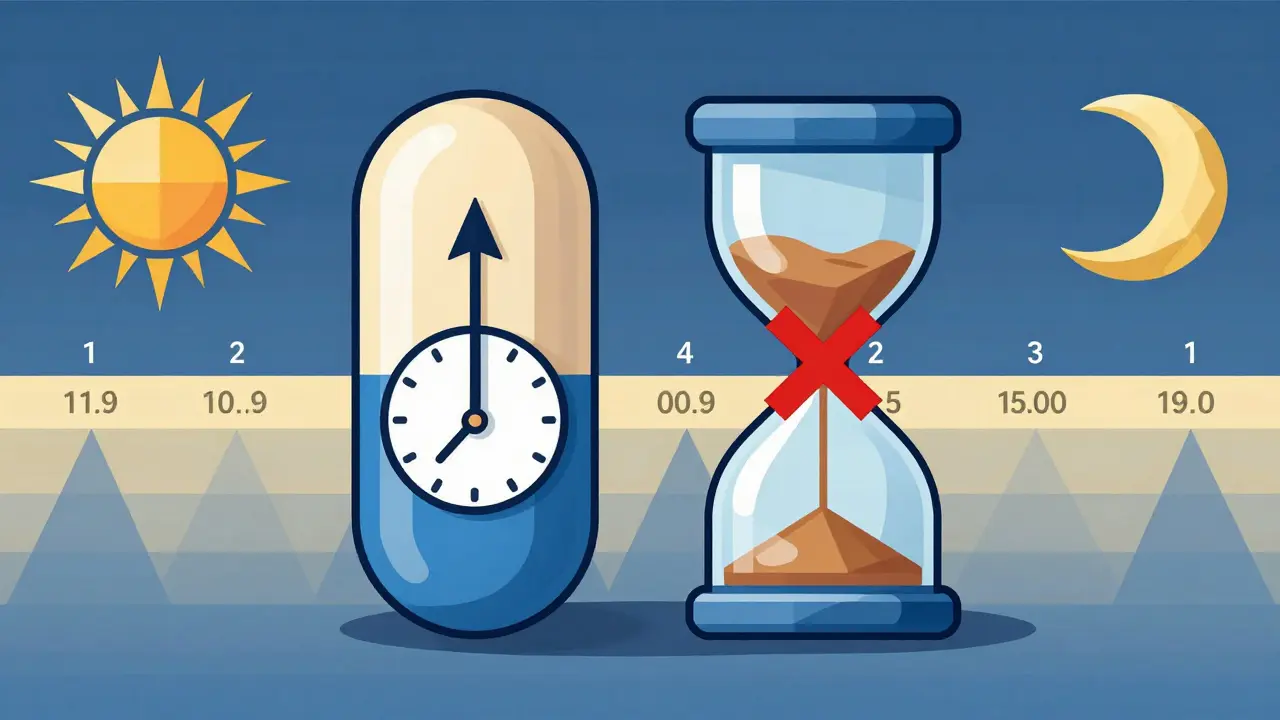
Time-released (or extended-release) melatonin is designed to last 6 to 8 hours. It’s meant for people who have trouble staying asleep - not for shifting your clock. When you take it for jet lag, you’re flooding your body with melatonin for hours. That’s the opposite of what your brain needs.Studies show that time-released melatonin produces less than half the phase-shifting effect of immediate-release at the same dose. One 2019 study found that 3 mg of immediate-release melatonin taken at 10 p.m. local time shifted the body clock by 1.8 hours. The same dose of time-released melatonin? Only 0.6 hours. That’s not just less effective - it’s nearly useless.
Worse, time-released melatonin can cause melatonin to linger into the morning. That’s bad. Your body should be completely clear of melatonin by sunrise. If it’s still present, your brain gets confused. It thinks it’s still night. That’s why travelers report waking up at 3 a.m. feeling wired, or being groggy all day. The CDC’s 2024 guidelines explicitly warn: “Slow-release melatonin is not recommended for jet lag because it stays in the system too long and confuses the circadian clock.”
Harvard Medical School’s Dr. Steven Lockley put it bluntly: “The circadian system responds to discrete melatonin signals, not sustained elevation.” Time-released melatonin doesn’t mimic nature. It muddles it.
What the Experts Say - And What Travelers Report
Leading sleep experts agree. The American Academy of Sleep Medicine gives a strong recommendation for low-dose immediate-release melatonin for eastward travel across two or more time zones. They state there’s “insufficient evidence” for time-released versions. The European Biological Rhythms Society, Stanford’s Dr. Jamie Zeitzer, and Brigham and Women’s Hospital’s Dr. Charles Czeisler all say the same: avoid extended-release for jet lag.Real travelers confirm this. A 2023 survey of over 5,200 frequent flyers found that those using time-released melatonin took 2.4 days longer to adjust than those using immediate-release. On Reddit, 78% of users who tried time-released melatonin said they felt worse - more groggy, slower to adapt. Amazon reviews for time-released products average 2.8 stars. Common complaints: “Woke up at 3 a.m. feeling wired,” and “Felt off for two days after my Tokyo trip.”
Meanwhile, immediate-release melatonin gets 4.1 stars. One Business Insider travel writer documented adjusting from New York to Tokyo in just 3.5 days using 1 mg immediate-release melatonin timed with an app. He said the time-released version he accidentally took once left him disoriented for two full days.
How to Use Immediate-Release Melatonin Correctly
If you’re going east - say, from Chicago to Dubai (9 time zones ahead) - here’s what works:- Start taking 0.5 to 3 mg of immediate-release melatonin 30 minutes before your target bedtime in Dubai - even if you’re still on Chicago time. For example, if you want to sleep at 11 p.m. Dubai time, take it at 10:30 p.m. Dubai time.
- Do this for 4 to 5 nights after arrival.
- For 5+ time zones east, start with 0.5 mg. For 7+ time zones, go up to 3 mg.
For westbound travel (e.g., New York to Los Angeles), the strategy is different. You want to delay your clock. Take melatonin in the morning - right after waking up - for 2 to 3 days. But this is less common and less studied. Most travelers don’t bother. Light exposure is more effective for westbound adjustment.
Timing matters more than dose. A 2002 study found 0.5 mg was just as effective as 5 mg for shifting your clock. Higher doses may help you fall asleep faster, but they don’t improve circadian adjustment. In fact, too much melatonin can cause headaches or dizziness.
What Else Helps - And What Doesn’t
Melatonin isn’t a magic pill. It works best with other tools:- Light exposure: Get bright natural light (2,000-10,000 lux) for 30-60 minutes after waking at your destination. Avoid bright light - especially blue light from screens - in the evening.
- Hydration: Drink water before, during, and after the flight. Avoid alcohol and caffeine close to bedtime.
- Sleep schedule: Try to sleep and wake at local times as soon as possible. Even if you’re tired, resist napping past 20 minutes.
Don’t rely on prescription sleep aids like zolpidem or stimulants like modafinil. They help you sleep or stay awake - but they don’t fix your clock. You’ll still feel off for days.

The Market and the Misleading Labels
The global jet lag market is worth over $1.7 billion. Melatonin makes up 68% of that. But here’s the problem: the FDA doesn’t regulate melatonin as a drug. It’s sold as a supplement. That means labels lie. A 2023 FDA warning found melatonin supplements contained 83% to 478% more or less than what’s listed on the bottle. You might think you’re taking 1 mg - you could be getting 3 mg or even 0.2 mg. That’s dangerous if you’re trying to time it precisely.Companies sell time-released melatonin as “better for all-night sleep.” That’s true for insomnia - not jet lag. But the packaging doesn’t make that distinction. Most travelers buy it because it’s labeled “slow-release” and assume it’s smarter. It’s not.
Forty-two Fortune 100 companies now give employees immediate-release melatonin and timing guides for international trips. Not one recommends time-released.
The Future: Precision and Personalization
New research is getting smarter. The NIH is studying how your genes affect melatonin timing. Some people have a CRY1 gene variant that shifts their optimal dosing time by over two hours. Apps like Timeshifter now use your flight path, chronotype, and sleep history to give you exact dosing times. These tools are growing - and they only work with immediate-release melatonin.Time-released melatonin has no place in this future. The Sleep Research Society predicts it will make up less than 5% of the jet lag market by 2030. The science is clear: precise timing beats prolonged exposure.





Sona Chandra
This is the most important thing I’ve read all year. Time-released melatonin is a scam sold by Big Sleep to keep you groggy and dependent. I took it for my Tokyo trip and woke up at 3 a.m. screaming into my pillow like a horror movie villain. I thought I was dying. Turns out I was just overdosed on fake science. NEVER AGAIN.