
Medication Reformulation Analyzer
Understanding the resource investment behind developing a brand-new molecule versus upgrading an existing therapy.
New Drug Development
| Avg. Cost | $2.6 Billion |
|---|---|
| Timeline | 10-15 Years |
| Success Rate | ~10% |
Medication Reformulation
| Avg. Cost | $50 - 100 Million |
|---|---|
| Timeline | 3-5 Years |
| Success Rate | ~30% |
Please select an option above to analyze potential formulation improvements.
Have you ever picked up your prescription bottle and noticed the tablet looks different? Maybe it's a smaller pill, a liquid instead of a solid, or even has a different taste. You aren't imagining things. Behind the scenes, companies frequently tweak how medicines are made without changing what actually makes you feel better. This process is known as medication reformulationa strategic process of modifying an existing drug's composition, delivery mechanism, or physical properties while maintaining the same active pharmaceutical ingredient. Also known as formulation optimization, it allows manufacturers to improve how a drug works or feels.
This isn't just about updating packaging. Sometimes, the internal chemistry of the capsule changes to help it dissolve faster or sit better in your stomach. While the core medicine remains the same, the way your body receives it gets upgraded. Understanding this shift matters because it directly impacts how you take your medicine and how much it costs.
What Exactly Changes During Reformulation?
To get clear on this, we need to separate two key parts of any pill: the active ingredient and the support system. The Active Pharmaceutical Ingredient (API)the chemical substance responsible for the therapeutic effect of the drug. is the magic worker. If you are taking ibuprofen for pain, ibuprofen is the API. In a true reformulation, the API usually stays exactly the same chemically.
The real action happens with the rest of the pill. We call the non-active materials excipients. These are fillers, binders, preservatives, and coatings that hold the pill together or control how it releases into your bloodstream. A pharmaceutical company might change these ingredients to reduce stomach upset. For instance, switching from a standard coating to an extended-release mechanism can prevent nausea without touching the actual painkiller itself.
- Changing Concentrations: Adjusting how much of the drug is in each unit.
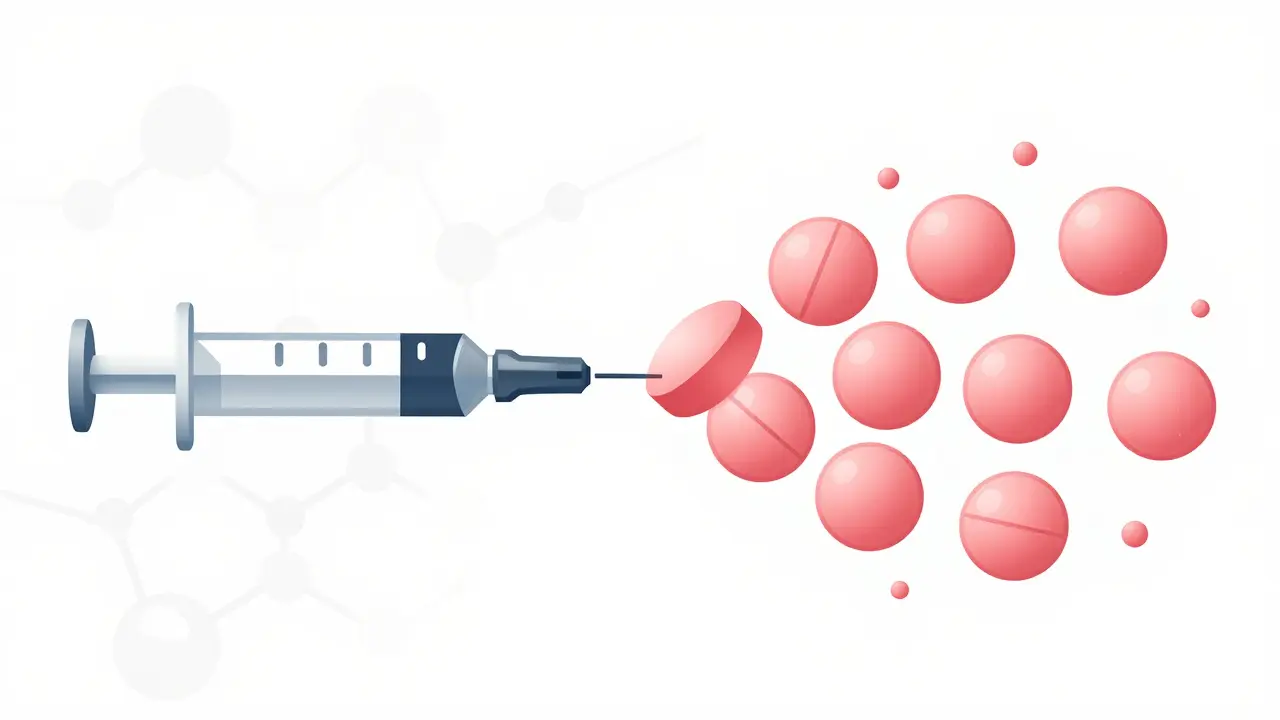
- Altering Delivery: Moving from a shot (injectable) to a pill (oral).
- Modifying Release: Making the drug release slowly over 12 hours instead of all at once.
This distinction is crucial. If the chemical structure of the API changes, it's a completely new drug. Reformulation keeps the API intact while upgrading everything around it.
Why Companies Update Drug Formulas
You might wonder why a company bothers tinkering with a formula that already works. There are genuine clinical reasons and business reasons. On the clinical side, experience teaches us how drugs behave in the real world. After a drug hits the market, millions of patients take it. Doctors then spot issues like "this pill makes me nauseous" or "I forget to take it because I have to prick my arm daily."
Data shows that reformulating a drug to improve patient experience often leads to better health outcomes. If a patient hates the side effects, they stop taking the med. By reformulating to remove those side effects, doctors ensure people actually finish their treatment course. According to recent industry analysis, about 30% of repurposed or reformulated drugs gain approval, which is three times higher than the rate for entirely new drugs.
There is also a commercial reality. Patents expire. When the exclusive rights to sell a specific version of a drug run out, cheaper generic versions flood the market. Companies reformulate to extend the product's lifecycle. This allows them to keep selling a proprietary version that is slightly better-perhaps easier to swallow or more stable in heat. While critics sometimes call this "evergreening," supporters argue it funds further research.
The Regulatory Shortcut: FDA Pathways
Developing a brand-new molecule from scratch takes forever and costs a fortune. It often takes 10 to 15 years and upwards of $2.6 billion to bring a totally new drug to market. Reformulation offers a middle ground. The United States Food and Drug Administration (FDA) created a specific pathway for this called the 505(b)(2) approval route.
This regulation lets developers rely on some existing data. Since we already know the API is safe, the FDA doesn't always require full-blown safety trials on healthy volunteers again. Instead, the focus shifts to Bioequivalencea measurement showing the new formulation delivers the active ingredient into the blood at the same rate and amount as the original.
| Feature | Novel Drug Development | Medication Reformulation |
|---|---|---|
| Average Cost | $2.6 Billion | $50-100 Million |
| Timeline | 10-15 Years | 3-5 Years |
| Approval Rate | ~10% | ~30% |
| Risk Level | High (Unknown Chemistry) | Moderate (Known API) |
If the new formula works differently-for example, delivering the drug through a patch instead of the mouth-the agency might require some new clinical data to prove safety in that new form. But generally, it cuts the red tape significantly. This efficiency attracts many mid-sized pharmaceutical firms to focus on optimizing older medicines rather than hunting for cures for diseases nobody else knows exist yet.
Impact on Patient Care and Compliance
For you, the person taking the medicine, the goal is simpler: does it work better? The biggest win from reformulation is compliance. Adherence to medication plans is notoriously poor. Some studies suggest up to half of patients with chronic conditions skip doses. Complex schedules or harsh side effects drive this behavior.
Imagine a drug originally designed as an injection that hurts when administered. A reformulated oral tablet removes the needles entirely. A patient who hated weekly shots might now happily take a daily pill. This switch transforms adherence. Furthermore, stability plays a role. Older formulations might degrade if left in a hot car or humid environment. Newer technologies allow the drug to stay potent longer, meaning less waste and fewer ineffective doses.
However, patients need to stay alert. Even though the active ingredient is the same, changing the filler ingredients can occasionally trigger allergies. Someone allergic to lactose might react to a new pill binder that didn't exist before. Always check the inactive ingredients list when your pharmacy hands you a new-looking bottle.
Is "Evergreening" a Problem?
The industry faces criticism regarding patent extension strategies. Critics argue that some companies make trivial tweaks just to delay cheaper generic competition. They claim this keeps prices high without offering meaningful improvements. For instance, changing the color of the pill counts as a new design in some contexts, potentially blocking immediate generic substitution.
Experts like Dr. Felicity Thomas note that while cost-efficiency is good, the ethical line lies in patient benefit. If the reformulation solves a real problem, like making a bitter-tasting syrup palatable for children, it's a win. If it just changes the sugar type to block competitors while adding zero benefit, it harms the healthcare system.
Regulators try to draw the line. In modern reviews, authorities scrutinize whether the new formulation actually provides a clinical advantage. If the answer is no, they push back. Still, the tension between innovation incentives and affordable access remains a heated debate in health policy circles today.

Real-World Success Stories
Not all reformulations are theoretical. Consider the case of orphan drugs. These treat rare diseases where patient numbers are low. A major firm might ignore developing treatments because the profit margin is tiny. A specialized biotech firm steps in to reformulate an existing safe compound into a form usable for that specific condition.
In one documented project involving a mid-sized developer, the team redesigned both the ingredients and the manufacturing process to hit aggressive timelines. They managed registration batches in just 12 months. This speed allowed patients access to effective therapy much sooner than traditional development would allow. By leveraging validated analytical methods, they ensured the final product met strict standards without unnecessary delays.
Looking ahead, technology drives more changes. Smart pills and injectable gels represent the next frontier. As material science improves, we will likely see more "drug-delivery systems" that target specific organs precisely, reducing side effects elsewhere in the body.
Navigating Changes to Your Medicine
When you spot a change, don't panic, but verify. Ask your pharmacist if the active ingredient dose remains identical. Compare the price, as reformulated branded versions are often more expensive than their predecessors until the new patents kick in fully. Most importantly, monitor how you feel. If your symptoms return or new issues arise after the switch, report them to your doctor immediately.
Your care provider should track formulation updates as part of the patient record. Keeping open communication ensures that any transition supports your health goals rather than complicates them. Ultimately, these scientific adjustments aim to bridge the gap between lab discoveries and your daily life, keeping therapies safe and relevant.
Does a reformulated drug contain the same active ingredient?
Yes, typically medication reformulation keeps the same Active Pharmaceutical Ingredient (API). The changes happen to the inactive components like fillers, coatings, or the delivery method, not the core chemical that treats the disease.
Why would a company change a working drug formula?
Companies reformulate to improve patient compliance, reduce side effects, extend shelf life, or adapt to new manufacturing technologies. Sometimes, it is done to manage patent lifecycles to protect intellectual property.
Is a reformulated drug considered a "new" drug?
It depends on the extent of the change. If the delivery mechanism changes (like injectable to oral), it may need more testing. However, under the FDA 505(b)(2) pathway, it relies heavily on existing data, distinguishing it from a brand-new molecular entity.
Can reformulation affect my side effects?
Yes. Changing the release mechanism or inactive ingredients can change how your body absorbs the drug. This might eliminate previous side effects but could rarely introduce new ones, particularly if you are sensitive to certain excipients.
How long does it take to approve a reformulated drug?
While novel drugs take over a decade, reformulation projects often complete within 3 to 5 years, with some specialized cases managing clinical registration in as little as 12 months depending on complexity and regulations.



Christopher Curcio
Bioavailability profiles shift slightly due to altered dissolution rates. Patient tolerability improves significantly with coated excipients. We should acknowledge the pharmacokinetic benefits here. Many patients benefit from reduced gastric irritation. It validates the therapeutic index improvements. The shift in delivery mechanisms often enhances absorption consistency across various metabolic types.