
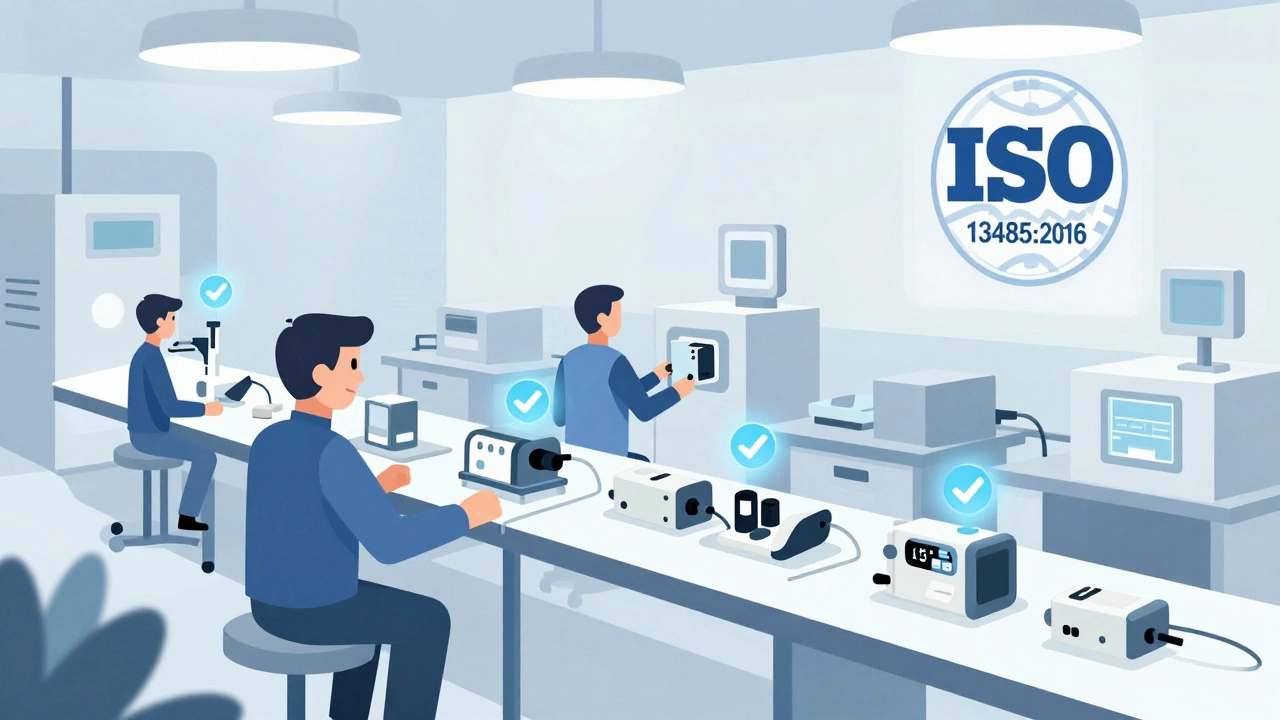
Why Quality Control in Medical Manufacturing Isn’t Just Bureaucracy
Every time someone gets a pacemaker, an insulin pump, or a surgical implant, they’re trusting that the device will work exactly as designed. No surprises. No failures. That trust doesn’t come from luck. It comes from quality control in manufacturing-a tightly woven system of rules, checks, and documentation built to stop defects before they reach a patient’s body.
It’s not about checking boxes. It’s about saving lives. The FDA estimates that strong quality systems prevent about 30% of device failures that could otherwise harm patients. That’s not a small number. That’s thousands of people each year who avoid hospitalization, surgery, or worse because someone followed a procedure exactly as written.
The Rules That Keep Devices Safe
The backbone of medical device quality control in the U.S. used to be 21 CFR Part 820-the FDA’s Quality System Regulation. It laid out 11 key areas manufacturers had to control: design, production, testing, documentation, corrective actions, audits, and more. But it was U.S.-only. If you wanted to sell your device in Europe, you needed a separate system based on ISO 13485.
That changed on January 31, 2024. The FDA issued its final rule: the Quality Management System Regulation (QMSR). Starting February 2, 2026, U.S. manufacturers must follow ISO 13485:2016. No more dual systems. No more confusion. The world’s most recognized medical device standard is now the law in America.
ISO 13485:2016 isn’t just a checklist. It’s built around risk management. Every design choice, every supplier, every step in production must be evaluated for potential harm. If a component could fail under heat or moisture, you document it. If software could glitch during surgery, you test it under worst-case conditions. This isn’t theory-it’s required.
What Gets Tested, and How
Quality control doesn’t stop at paperwork. It happens on the factory floor. At every stage, from raw materials to finished product, checks are made.
- Incoming inspection: Every screw, circuit board, and plastic housing is checked against specs. One bad batch can ruin thousands of devices.
- In-process checks: During assembly, automated systems monitor torque, temperature, and alignment. If a machine drifts out of tolerance, it stops.
- Final testing: Each device is powered on. Electrical safety tests require a minimum 1,500-volt dielectric strength test. Leakage current must stay under 100 microamperes-less than the tingling you feel from a static shock.
Statistical Process Control (SPC) tracks these measurements over time. If a variable starts trending upward-like increased resistance in a connector-it triggers an investigation before a defect is made.
And traceability? Non-negotiable. Every device has a unique identifier. If a problem pops up six months later, you can pull up its entire history: who made it, what batch of material was used, which operator ran the machine, and what tests it passed. This isn’t just for recalls. It’s for learning. It’s how you fix the root cause, not just the symptom.

The Real Cost of Cutting Corners
Some manufacturers think quality control is expensive. They’re right. But they forget what’s costlier.
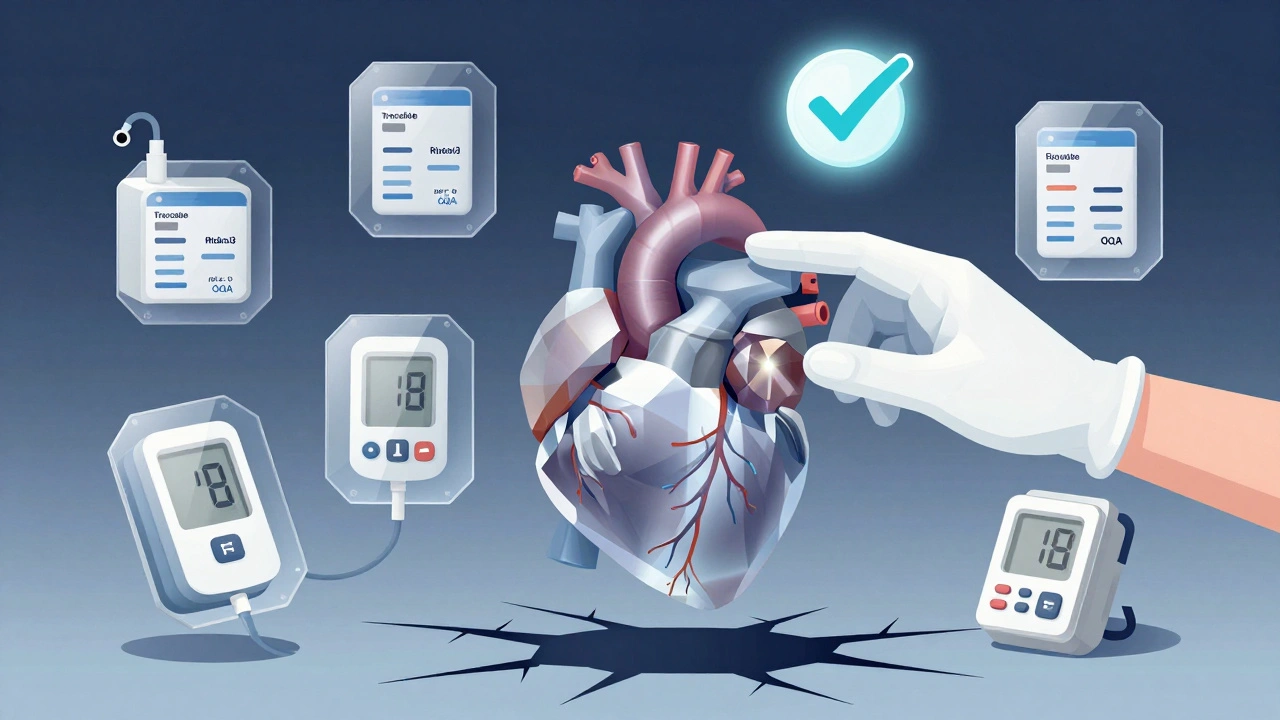
A Class I recall-the most serious type-can cost over $5 million in lost product, legal fees, and reputational damage. The FDA issued 217 warning letters in 2023 alone. Over 40% of them cited poor supplier oversight. One company shipped 12,000 glucose monitors with a faulty sensor because they didn’t audit their Chinese supplier. Patients got wrong readings. Hospitals had to replace devices. The company lost its FDA clearance for a year.
Meanwhile, companies with mature systems see results. AAMI found that top performers had a 99.97% first-pass yield. That means almost every device leaves the line without needing rework. The average? 98.2%. That 1.77% gap? It’s 17 times more defects. More returns. More lawsuits. More risk to patients.
Dr. Jeffrey Shuren, head of the FDA’s device division, said in 2023 that strong quality systems prevent about 200,000 adverse events each year. That’s not a guess. That’s based on incident reports, root cause analyses, and trend data from hospitals and clinics.
How Companies Are Doing It Right
Greenlight Guru, a quality management software platform used by over 1,000 medical device companies, reports that clients using its FDA-aligned templates see 32% higher audit success rates. Why? Because they’re not trying to guess what the FDA wants. The software walks them through each requirement with real examples.
One Director of Quality at a company making spinal implants told LinkedIn they caught a software bug in a 5,000-device batch before it shipped. The change had been approved on paper-but never tested under real surgical conditions. The traceability matrix flagged it. They pulled the batch. No one got hurt. No recall. Just good process.
On Reddit, a senior quality engineer shared that after switching to ISO 13485:2016, their corrective action cycle dropped from 45 days to 17. That’s not magic. It’s clearer ownership, better documentation, and fewer back-and-forths between departments.
The Hidden Trap: Paper Quality Systems
But here’s the danger: some companies think if they have the right forms, they’re compliant. They don’t.
Dr. Marc Jacobi, a former FDA reviewer, calls these "paper quality systems." They have perfect records. But when a machine breaks, or a worker makes a mistake, no one knows how to fix it. The system doesn’t work in real time.
23% of FDA 483 observations-those warning letters issued during inspections-are for inadequate process validation. The paperwork is there. The procedures are written. But no one actually tested whether the process works under real conditions.
Quality control isn’t about having a thick binder. It’s about having people who understand the process, can spot when something’s off, and have the authority to stop production.
What’s Changing in 2025-2026
The transition to ISO 13485:2016 as the U.S. standard is happening in phases. By Q3 2025, most large manufacturers will be fully compliant. Smaller companies-under 50 employees-are struggling. They don’t have dedicated compliance teams. They rely on consultants. The FDA is offering free guidance, but the learning curve is steep.
Training is key. Production staff need 40-80 hours of training on their specific process controls. Quality staff need 6-12 months to master risk management under ISO 14971. It’s not a one-day workshop. It’s a cultural shift.
And it’s not stopping there. Drafts for ISO 13485:202X are already in progress. The next version will include stronger cybersecurity requirements. Why? Because more devices are connected. A smart infusion pump can be hacked. A pacemaker’s software can be altered. Quality systems now must protect not just physical safety, but digital integrity.
What’s Next: AI and Automation
Some companies are already using AI to predict quality issues. Machine learning analyzes sensor data from production lines-vibration, temperature, voltage-and flags anomalies before a defect occurs. Early adopters report 25-40% fewer defects.
Gartner predicts that by 2027, 60% of medical device quality systems will use AI-driven analytics. That doesn’t mean humans are out of the loop. It means they’re freed from manual inspections to focus on solving deeper problems.
The goal isn’t to replace people. It’s to give them better tools. Better data. Faster feedback. So they can act before a patient is at risk.
Final Thought: It’s Not About Compliance. It’s About Care.
At the end of the day, every SOP, every test, every audit trace back to one thing: protecting someone who’s vulnerable.
A child with a ventilator. An elderly person with a joint replacement. A diabetic relying on a continuous glucose monitor. They don’t care if your system is ISO 13485 compliant. They care that it works.
Quality control in manufacturing is the last line of defense. It’s the reason a device doesn’t fail in the operating room. It’s why a patient sleeps safely at night. And it’s why every step, no matter how small, matters.
What is ISO 13485:2016 and why does it matter for patient safety?
ISO 13485:2016 is the global standard for quality management systems in medical device manufacturing. It requires companies to systematically manage risks, document every step of production, and ensure devices work safely under real-world conditions. Since it became the mandatory standard in the U.S. as of February 2, 2026, it ensures all manufacturers-no matter where they’re based-follow the same safety rules. This reduces the chance of defective devices reaching patients.
How does the FDA enforce quality control in medical device manufacturing?
The FDA enforces quality control through inspections, warning letters, and enforcement actions. Manufacturers are inspected every 2-5 years based on risk. Inspectors check documentation, observe production, review test records, and interview staff. If they find serious gaps-like unvalidated processes or poor supplier oversight-they issue a 483 observation or a warning letter. Repeated failures can lead to product seizures or bans.
What happens if a medical device fails quality control?
If a device fails quality control, it’s held back from shipment. If it’s already in the market, the manufacturer must initiate a recall. Class I recalls are the most serious-used when a device could cause serious injury or death. The FDA requires the company to notify users, retrieve the product, and fix the root cause. Failure to act can result in legal penalties and loss of FDA clearance.
Can AI really improve quality control in medical manufacturing?
Yes. AI analyzes real-time data from sensors on production lines to spot subtle patterns that humans miss-like a slight increase in motor vibration or a temperature drift. Early adopters have reduced defect rates by 25-40%. AI doesn’t replace inspectors; it gives them alerts so they can investigate before a batch is compromised. This turns quality control from reactive to predictive.
Why do some companies fail at quality control even when they have the right paperwork?
They create "paper quality systems"-perfect documentation without real understanding. Workers follow procedures mechanically, but don’t know why. If a machine behaves oddly, no one knows how to respond. The FDA found that 23% of inspection findings involve this gap: procedures exist, but process validation is weak. True quality means people understand the risks and can act when something’s wrong.
How long does it take to implement a compliant quality system?
For Class II or III medical devices, it typically takes 12-24 months. The first 4-8 weeks are spent on a gap analysis. Then comes training, updating procedures, validating processes, and integrating software. Smaller companies often take longer due to limited staff. Full compliance requires buy-in from engineering, production, and management-not just the quality department.



Doris Lee
Just wanted to say this is one of the clearest explanations I’ve read on medical QC. It’s easy to forget that every screw tightened and every voltage tested is someone’s safety net. Thank you for writing this.