
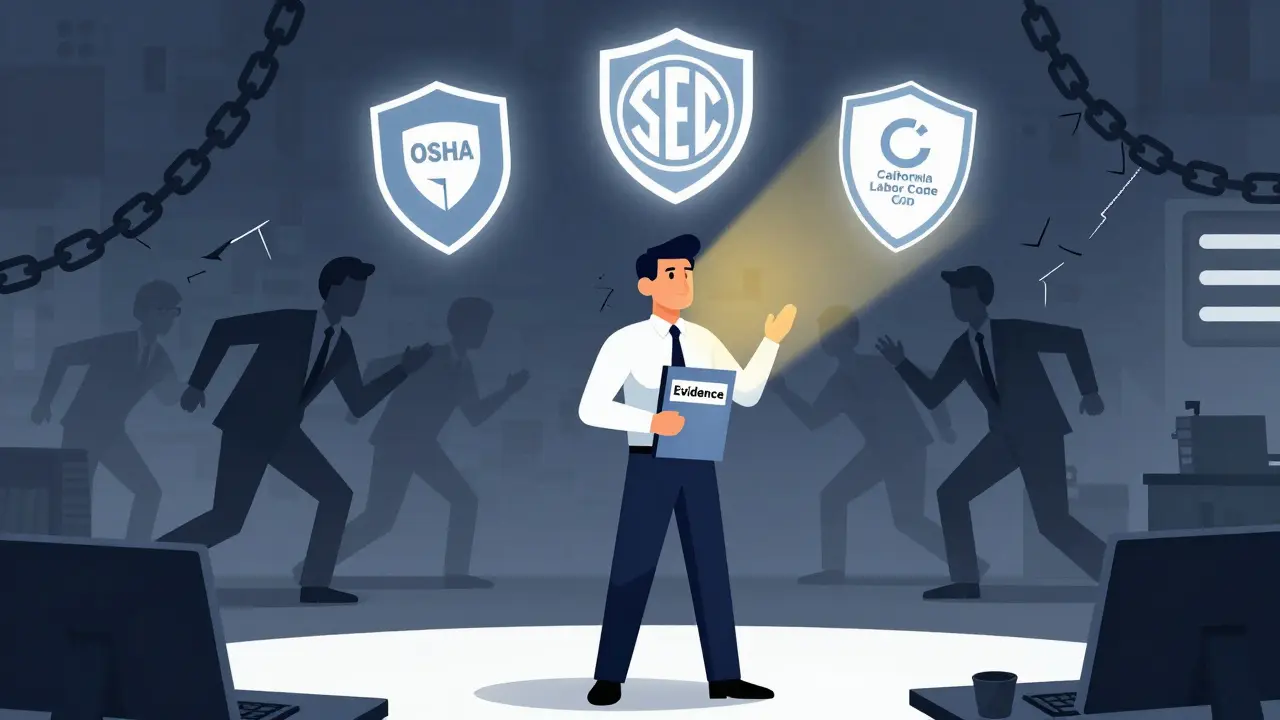
When you see something wrong at work - unsafe conditions, financial fraud, or cover-ups that put people at risk - speaking up shouldn’t cost you your job. But too often, it does. That’s where whistleblower laws come in. These aren’t just legal technicalities; they’re lifelines for people who refuse to stay silent when their employer breaks the law.
What Exactly Counts as Protected Reporting?
Whistleblower protections don’t just apply to corporate spies or secret informants. They cover everyday workers who report violations they reasonably believe are illegal. Under California’s Labor Code Section 1102.5, which is one of the strongest state laws in the U.S., protected activity includes telling your boss, filing a complaint with a government agency, or even just asking HR about a suspicious practice - as long as you have reason to think a law is being broken.This isn’t limited to obvious crimes. Reporting unsafe equipment, falsified safety logs, environmental violations, or even misleading patients about treatment options can all qualify. The law protects you even if your report turns out to be wrong - as long as your belief was honest and based on facts you had at the time.
And it’s not just current employees. Job applicants who are denied a position after speaking up, or even people who are targeted just because someone thinks they might report something, are covered. That’s a big deal. It means your rights kick in before you even start the job.
What Kind of Retaliation Is Illegal?
Retaliation doesn’t always come in the form of a pink slip. Sometimes it’s quieter - and harder to prove. Illegal retaliation includes:- Getting fired, laid off, or forced to quit
- Being demoted or moved to a worse shift
- Having your hours cut or pay reduced
- Being denied promotions or training
- Receiving unfair performance reviews
- Being isolated, mocked, or harassed by coworkers or managers
- Being threatened with disciplinary action for speaking up
One worker in San Diego reported a safety violation to OSHA and was soon assigned to overnight cleaning shifts - 12 hours alone, with no support. The job was physically brutal, and they eventually quit. That’s not a coincidence. That’s retaliation, and it’s illegal under California law. But proving it? That’s where things get messy.
Federal vs. State: Which Protections Are Stronger?
The U.S. doesn’t have one whistleblower law - it has over 25, each covering different industries. The federal system is a patchwork. For example:- The Sarbanes-Oxley Act protects workers at public companies who report financial fraud.
- The False Claims Act covers people who report fraud against government programs - like Medicare scams or defense contractor overbilling.
- The Dodd-Frank Act goes further: if your tip leads to a fine over $1 million, you can get 10% to 30% of the money back. In 2023, the SEC paid out $637 million to 131 whistleblowers.
- The AIR21 Act protects airline workers who report safety issues - but it has a major loophole: OSHA often misses its 90-day deadline to investigate complaints, leaving workers in limbo.
California’s law, on the other hand, is broader. It covers reports of violations of any state or federal law - not just specific ones. And starting January 1, 2025, every employer in California must post a clear notice about whistleblower rights in a visible spot - at least 14-point font - with the state’s hotline number (1-800-952-5225). Failure to do so can cost them up to $10,000 per violation.
But there’s a trade-off. Federal laws let you sue in federal court. California workers under Section 1102.5 can’t. They’re stuck in state labor courts, which are slower and often less favorable to employees. So while California’s rules are more inclusive, the federal system sometimes offers more powerful legal tools.
What You Need to Do Before You Speak Up
If you’re thinking about reporting, don’t just walk into HR and hope for the best. Here’s what actually works:- Document everything. Save emails, text messages, shift logs, safety reports - anything that shows you reported something and what happened after.
- Know the deadlines. Federal claims have strict time limits: 30 days for Clean Air Act complaints, 90 days for anti-money laundering reports, 180 days for financial fraud under Dodd-Frank. Miss the window, and you’re out.
- File with the right agency. OSHA handles most workplace retaliation claims. For financial fraud, go to the SEC. For Medicare fraud, contact the Department of Health and Human Services.
- Get legal advice. The National Whistleblower Center says 78% of successful cases had a lawyer. Most free legal aid programs won’t take whistleblower cases unless they’re strong from the start.
Remote workers face extra hurdles. California’s law says employers can email the whistleblower notice - but what if you work from home? The law doesn’t say. That’s a gray area, and employers are exploiting it.
Why So Many Whistleblowers Still Get Crushed
The system looks good on paper. But reality is different. A 2024 survey by the National Whistleblower Center found that 68% of whistleblowers still faced retaliation - even with laws in place. Why?- HR departments often don’t know the law. A 2024 California Chamber of Commerce survey found 65% of small business owners didn’t know about the new 2025 posting requirement.
- OSHA is overwhelmed. In 2024, OSHA missed its investigation deadline in 63% of federal whistleblower cases. The average case takes 22 months to resolve in California - and that’s if you’re lucky.
- Retaliation is hidden. Instead of firing you, they make your job unbearable. Assign you impossible tasks. Exclude you from meetings. Give you the worst clients. It’s not illegal on its own - until you prove it’s connected to your report.
One nurse in Los Angeles reported a pattern of understaffing that led to patient harm. She was told she was “not a team player.” Her performance reviews tanked. She was fired six weeks later. She filed a claim. Two years later, she won $287,000 in back pay - but she lost her career momentum, her savings, and her trust in the system.
What’s Changing in 2025?
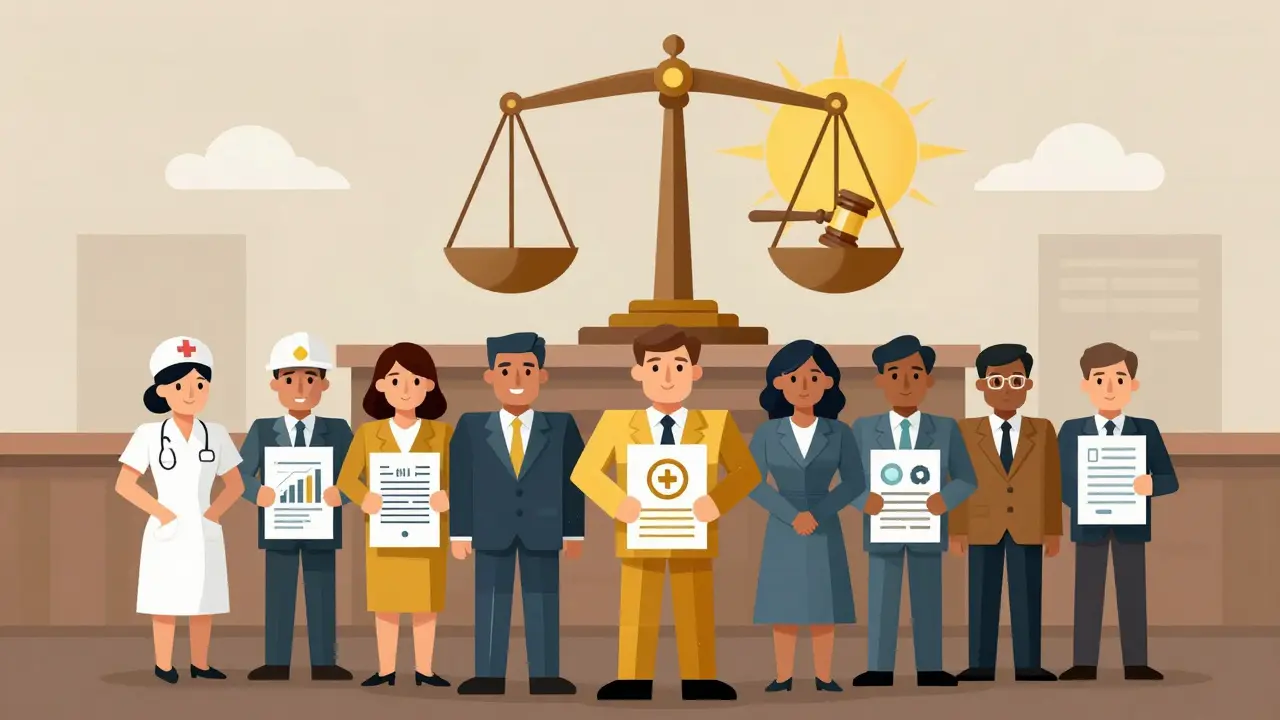
California’s new law (AB 2299) is a game-changer. For the first time, every employer - from a 3-person startup to a 10,000-employee hospital - must visibly display whistleblower rights. That’s not just a reminder. It’s a legal signal: we’re watching you.But it’s not just California. The federal government is catching up. In May 2025, Senator Grassley introduced the AI Whistleblower Protection Act, which would protect tech workers who report unethical AI practices - like biased algorithms used in hiring or dangerous autonomous systems. That’s a first. It shows lawmakers are starting to see that whistleblowing isn’t just about factories and banks anymore.
The Department of Labor is also working on new rules to cut investigation times from 90 days to 60. That won’t fix everything, but it’s a step.
Where to Turn for Help
You don’t have to go it alone. Here are real resources you can use right now:- California Attorney General’s Whistleblower Hotline: 1-800-952-5225 (free advice, no judgment)
- OSHA Whistleblower Protection Program: 1-800-321-6742 (for federal claims)
- National Whistleblower Center: Offers free legal assistance to over 1,200 people in 2024 alone
- SEC Whistleblower Office: If you’re reporting financial fraud, they pay rewards
These aren’t just phone numbers. They’re lifelines. People who call them before acting - not after getting fired - have a 70% higher chance of winning their case.
Final Thought: Speaking Up Is Hard - But It Matters
Whistleblower laws exist because history proved that silence is deadly. The 1986 Medicaid fraud scandal, the 2003 Columbia shuttle disaster, the 2010 Deepwater Horizon spill - all were preventable if someone had spoken up and been protected.These laws aren’t about being a hero. They’re about keeping systems honest. The next time you see something wrong, remember: you’re not just protecting yourself. You’re protecting patients, customers, workers, and the public.
It’s not easy. But it’s worth it.
Can I be fired for reporting a violation if I’m an at-will employee?
Yes, you can be fired - but not because you reported a violation. At-will employment means your employer can fire you for almost any reason - except illegal ones. Whistleblower laws make retaliation illegal, even in at-will states. If you’re fired after reporting, you can still file a claim. The burden of proof is on your employer to show the firing had nothing to do with your report.
What if I report anonymously?
You can report anonymously to government agencies like OSHA or the SEC - and you’ll still be protected. But if you report internally (to your boss or HR), anonymity is harder to maintain. Employers often figure out who spoke up. If you’re worried, use official channels first. Your identity is protected by law once you file a formal complaint.
Do whistleblower laws protect me if I report outside my company?
Yes. In fact, many laws require you to go outside the company to qualify for protection. Under California’s law, reporting to a government agency, law enforcement, or even a public body like the media is protected. Federal laws like Dodd-Frank and the False Claims Act also reward external reporting. Internal reports are protected too - but going outside often gives you stronger legal footing.
How long do I have to file a whistleblower claim?
It depends on the law. For federal claims, deadlines range from 30 to 180 days. For example: 30 days for Clean Air Act violations, 90 days for anti-money laundering, and 180 days for financial fraud under Dodd-Frank. California’s Labor Code Section 1102.5 gives you three years from the retaliation to file. Miss the deadline, and you lose your case - no exceptions.
Can I get paid for reporting fraud?
Yes - but only under certain laws. The False Claims Act and Dodd-Frank Act offer financial rewards. If your information leads to a successful government recovery over $1 million, you can get 10% to 30% of the total amount. In 2023, the SEC paid $637 million to whistleblowers. But this only applies to fraud against the government or securities fraud - not general workplace safety or discrimination claims.
What if my employer says I didn’t have proof?
You don’t need to prove the violation actually happened. You only need to show you had a reasonable belief it was happening. That means: you saw something suspicious, you had facts to support it, and you acted in good faith. Courts don’t require perfection - just honesty. If your employer says “you didn’t have proof,” they’re misrepresenting the law.
Are government workers protected too?
Yes, but under different rules. Federal employees are protected by the Whistleblower Protection Act (1989) and its 2012 update. However, these protections are weaker than state laws. Federal workers can’t sue in court - they must go through the Merit Systems Protection Board, which has a low success rate. Many federal whistleblowers end up quitting or being pushed out before their case is resolved.
Can I be sued for reporting?
Generally, no - as long as you report in good faith. Whistleblower laws shield you from lawsuits like defamation or breach of contract if your report is honest and based on facts. But if you lie, make up evidence, or leak confidential data without legal justification, you could face legal consequences. Always consult a lawyer before sharing internal documents.



Casey Tenney
They think they're heroes? Nah. They're just the guy who got caught texting in the break room and now blames HR for his termination. Real whistleblower? You don't need a law. You need guts. And if you need a law to protect you, you probably shouldn't have spoken up in the first place.